
The World Is Changing Next Door
Louisiana has recently made national headlines as a destination for investment from some of the largest companies not only in the United States but also in the world. Nineteen industrial megaprojects now announced in Louisiana add up to roughly $300 billion, from AI data centers in the Delta to LNG (liquefied natural gas) terminals on the Calcasieu Ship Channel to a SpaceX launch complex in the Vermilion Parish marsh. Governor Jeff Landry says the state has drawn more than $250 billion in new investment since he took office.
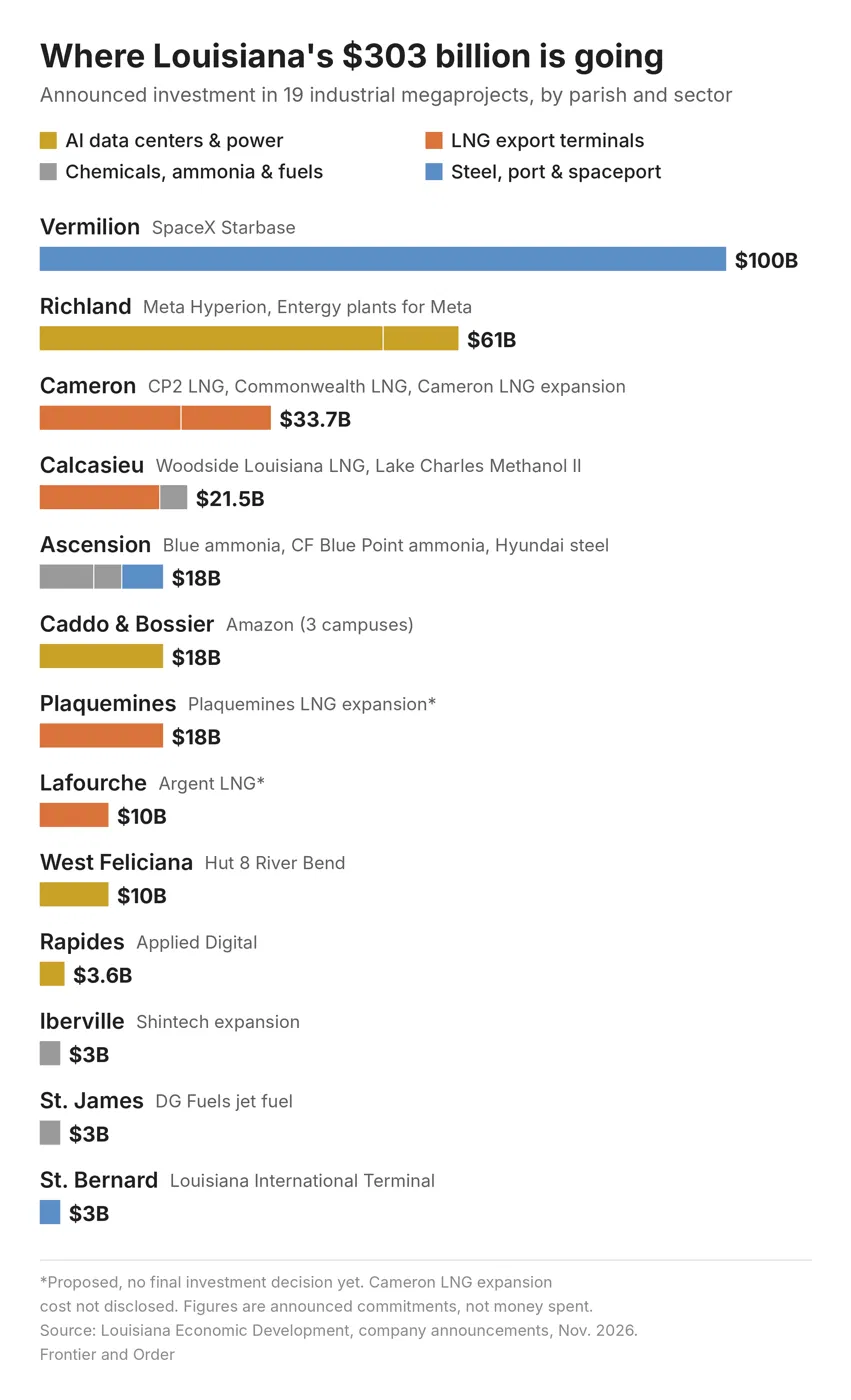
Louisiana’s 19 announced megaprojects by parish and sector. Source: Louisiana Economic Development and company announcements, November 2026.
Why Louisiana?
This amount of growth may come as a surprise, but Louisiana sits on top of what this generation of industry will continue to need: cheap access to energy, large amounts of flat land, water, and bureaucracy willing to move quickly.
Gas deposits like the Haynesville Shale produced about 14% of U.S. dry gas in 2024, per EIA data cited by Argus Media. LSU economist Loren Scott calls it "an ocean of gas" for power plants, a fuel source close to the industries that need it most, from data centers to SpaceX rockets bound for space. Henry Hub, the national gas price benchmark, sits outside Lafayette, and about two-thirds of U.S. LNG exports already leave through Louisiana, per Kpler data reported by Pipeline & Gas Journal.
Along with gas, Louisiana has the land and water needed to operate at megaproject scale without completely depleting local resources. Rural north Louisiana has open land and cooling water, and the Mississippi River and ship channels give coastal plants process water and a route to world markets.
Land and gas can be found in other states, but Louisiana stands out for its willingness to foster a positive relationship with large corporations. "What attracts data centers is speed to market," economist Ning Lin told The Advocate. Louisiana fast-tracks power plants for data centers under a "Lightning Speed" framework, exempts data center equipment from sales tax for up to 30 years, and offers property tax breaks through its Industrial Tax Exemption Program.
However, this mix of speed and incentives has bred secrecy: at least 50 public officials have signed nondisclosure agreements with the state's economic development agency since 2024. The agency calls NDAs essential to winning deals, but Lt. Gov. Billy Nungesser told WWNO they left him in the dark. Cheap land and parishes hungry for a tax base make it easy to say yes, which speeds deals but weakens the state's bargaining power.
The Expected Outcome on the Ground
With Louisiana chosen as an optimal location, companies must begin the practical process of opening positions to workers across the nation. This boom brings a large but temporary wave of builders and a much smaller permanent workforce. Meta alone expects more than 7,500 workers at peak, per Remio, swelling Richland Parish by nearly 50% each workday, local officials told GovTech. Woodside's LNG plant will support about 15,000 jobs during construction.
With construction ongoing, essential professions will also be required. Positions include fiber-optic technicians (Meta predicted to supply up to $6 billion of cable), transmission and grid storage centers, pipeline infrastructure, and local suppliers offering services to the $1.6 billion in contracts Meta says it will award to local Louisiana businesses (per Louisiana Economic Development). Along with these technical skills, general infrastructure will see a massive expansion with $1 billion for local roads, water, and wastewater, per HotHardware.
Location Considerations
These sums, spread across the state, affect residents in real and meaningful ways. Richland Parish got a single $22.4 million sales tax payment from Meta, more than the parish collects in most years. The payment funded teacher bonuses of up to $50,000, per GovTech, and Monroe's schools saw a 38% bump as well. But that payment came at a reduced 1% rate, and Richland granted a 30-year property tax break of up to 80%, per the Shreveport-Bossier Advocate.
Any industrial expansion also comes with a price paid by the state and its residents. Meta's site is registered to draw more than 23 million gallons a day from the regional aquifer, though Meta says its closed-loop design uses little most of the year. On the coast, Louisiana loses a football field of wetland about every 100 minutes, and that eroding, hurricane-exposed edge is where the LNG terminals and SpaceX are building. Calcasieu Pass exceeded its air permit limits 139 times in 2022, per Verite News, and Cameron shrimpers warn the buildout could end their industry.
With these costs considered, there is precedent for a path that benefits both sides. In Loudoun County, Virginia, outside capital turned farmland near Washington into the world's largest data center market. Data centers now pay $1.2 billion a year in property tax, about 39% of the county budget, per Loudoun County, letting the county cut homeowner taxes every year for a decade while raising school funding. The costs are transmission lines through neighborhoods, generator noise, and dependence on one industry.
Overall, Louisiana did not land $300 billion by accident. Its gas, flat land, water, and speed to market made it one of the most attractive places in the country to build data centers, LNG terminals, and a spaceport. The construction wave is already bringing thousands of builders, and behind them come fiber technicians, transmission and pipeline crews, and local suppliers. The buildout also carries real costs, from demand on the regional aquifer to heavy industry on an eroding, hurricane-exposed coast.
With the plants, the workforce, and the momentum in place, the real test will be what remains once the construction crews move on and leave behind projects with lasting environmental, security, and industrial impact.
Key Insights
If you forget everything else from this analysis, keep these in mind:
Louisiana has drawn 19 industrial megaprojects worth roughly $300 billion because it has what this generation of industry needs most: cheap gas, flat land, water, and a government willing to move fast.
The boom brings a large but temporary wave of builders, followed by a second wave of fiber technicians, transmission and pipeline crews, and local suppliers.
The money is already reaching communities, from teacher bonuses of up to $50,000 in Richland Parish to $1 billion for local roads, water, and wastewater. It also comes with real costs, from demand on the regional aquifer to heavy industry on an eroding, hurricane-exposed coast.
Loudoun County, Virginia, shows that a lasting path is possible. The real test for Louisiana is what remains once the construction crews move on.
